
James Hehir Building – Site of Medieval Shipbuilding
Long before the sleek glass and steel of the James Hehir Building behind you rose above the Wet Dock, this stretch of Ipswich’s waterfront was a hive of Victorian industry and maritime life.
This was a place of labour and ambition, where Ipswich’s fortunes were shaped by trade and tide. The waterfront was also a place of transformation — as Victorian engineering and enterprise reshaped the town’s identity, turning it from an ancient port town into a thriving centre of the industrial revolution. In the centuries before the dock was built, this part of the town’s waterfront had been occupied by early medieval shipyards, and later, quite possibly, the site of the construction of the Mayflower, and before that, early English royal warships.
When completed in the mid-1800s, the Wet Dock was the largest impounded high water level dock in the country. It was here that Robert Ransome had established his ironworks using the water flowing down from John Cobbold’s Holywells springs. His ironworks was the forerunner of the huge Ransomes, Sims and Jeffries Waterside works employing many thousands of men and women and building agricultural machinery of all kinds for export to almost every country in the world. As well as agricultural machinery, particularly ploughs, they built traction engines, railway engines, the town’s electric trams, buses and even aeroplanes. These were exported by ship directly from their Ransomes (now Orwell) Quay outside, and by rail with the dock tramway’s sidings running right into the factory. Their huge foundry added to the noise, and from where the workers were provided with free daily beer from the adjacent Steamboat Inn, still standing round the corner in Duke Street. Before the building of the dock, and soon after the invention of the steam engine but long before the railway first came to Ipswich, the country’s first paddle steamers had provided a regular service from here to London in 1815, hence the Inn’s name.
Though the University’s James Hehir building and the Main building beside Coprolite Street are a modern tribute to progress and education, their foundations rest on centuries of history. They stand where generations of workers once toiled in ship building, manure and fertiliser production, brewing, rope and sail making and grain storage.
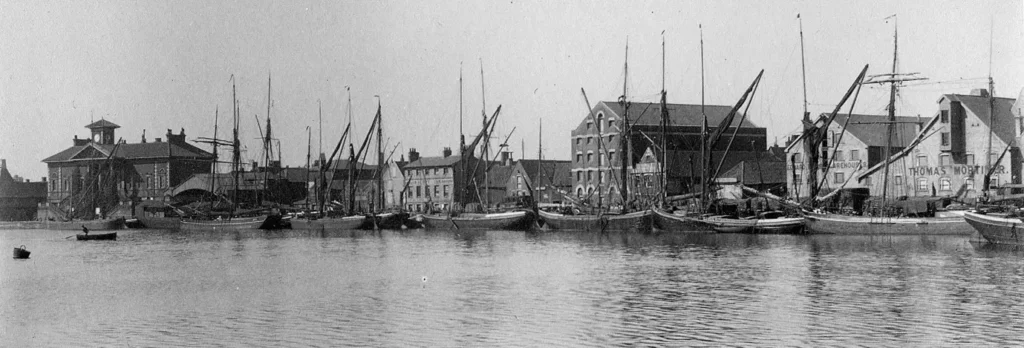
Before all the new 20th and 21st century developments, this was the view of the Waterfront looking across the dock from today’s Orwell Quay.
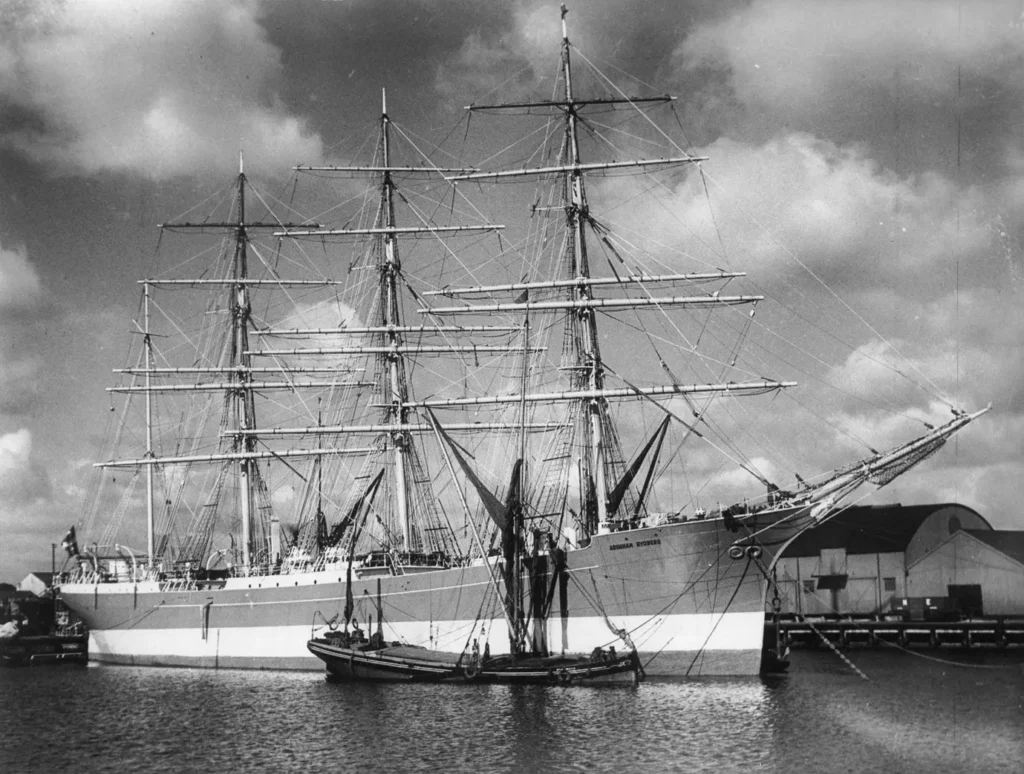
Across the dock discharging her cargo of Australian wheat into a Cranfield’s Mill barge is the very last huge clipper sailing ship to trade into the dock, the Abraham Rydberg. On the right you can see the huge curved roof of the Public Warehouse on the island site, still standing today.
The photographs for this article are reproduced courtesy of the Ipswich Maritime Trust Image Archive: Leonard Woolf and Richard Smith Collections.
This content has been developed with generous time and expertise donations from a number of people whom we thank for their contributions. The author of the content is Stuart Grimwade.
There are six binoculars in key historic locations around the town. You can find them all here
You can also download a map kindly curated by Historic Towns Trust on their 1904 map of Ipswich, showing the location of each set of binoculars and what the town around them used to look like.
Photographs from the Ipswich Maritime Trust’s Image Archive helped inform what you see and the content on this website.
Members of the Ipswich Maritime Trust, the Historic Towns Trust, the towns’ Tourist Guide Association and other wonderful members of the public shared their expertise on the history of Ipswich to help guide the designs and keep them accurate.
Our partners at Zubr have made the technology a reality and supported the project at every step, designing the first content themselves and ensuring these are a fantastic addition to Ipswich.
Kindly funded by the Ipswich Towns Fund


If you find anything wrong with our binoculars, please let Ipswich Borough Council know by clicking this link.
Please note the binoculars may be asleep when you approach, give them a wiggle to wake them up.
Brought to you by Ipswich Central, the Business Improvement District (BID) for the town centre and waterfront thanks to Ipswich Borough Council and Towns Deal funding.
The copyright of all content on this site, including images, belongs to Locus Management Solutions Ltd. Company registered in England.
Registration No: 5339846. Registered Office: The Master’s House, 19 Lower Brook Street, Ipswich, Suffolk IP4 1AQ.