In front of an iconic Ipswich building, take a look at what its previous inhabitants may have seen through their windows...
Customs House – Gateway to a Thriving Port
We are on the Common Quay which has served as the town public quay for at least the past six hundred years. Beneath the quay lie the ancient Anglo-saxon quays, and even earlier ones going back to the seventh century, making Ipswich the oldest continuously occupied English town.
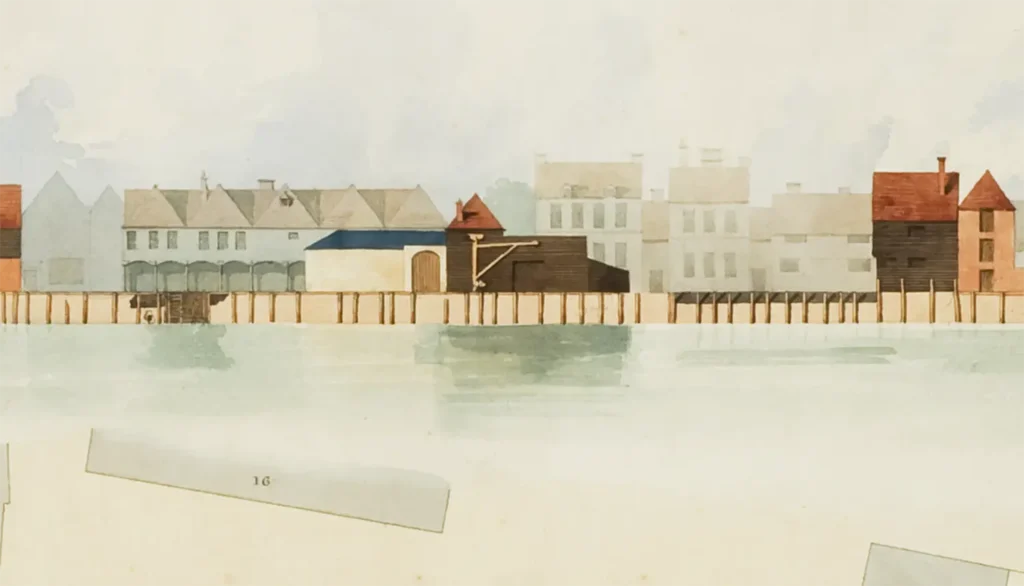
In 1837 a young surveyor Edward Caley was appointed by the dock engineer Henry Palmer to make a detailed survey of the whole waterfront before construction of the Wet Dock that we see today. He began by making careful drawings of all the buildings. His watercolour drawings show the waterfront when the town’s quays were tidal with wooden jetties leading up to the merchants’ houses and their warehouses. This is a small extract from his drawings showing the Common Quay with its public crane and medieval Custom House, soon to be demolished to make way for our fine current one.
From the mid-Victorian era, the Customs House behind you stood as a sentinel of commerce and control at the edge of Ipswich’s bustling new Wet Dock — a grand symbol of the town’s maritime ambition and industrial progress.
Built in 1845, this elegant neoclassical building was more than just an administrative centre; it was the nerve centre of Ipswich’s thriving port. As steamships replaced sail and global trade expanded, the Customs House became a hive of activity. Clerks in starched collars and ink-stained cuffs processed goods from across the Empire — tea from India, timber from Scandinavia, exotic fruits from the Caribbean, and wheat from Australia and Canada — all arriving through the dock’s busy quays.
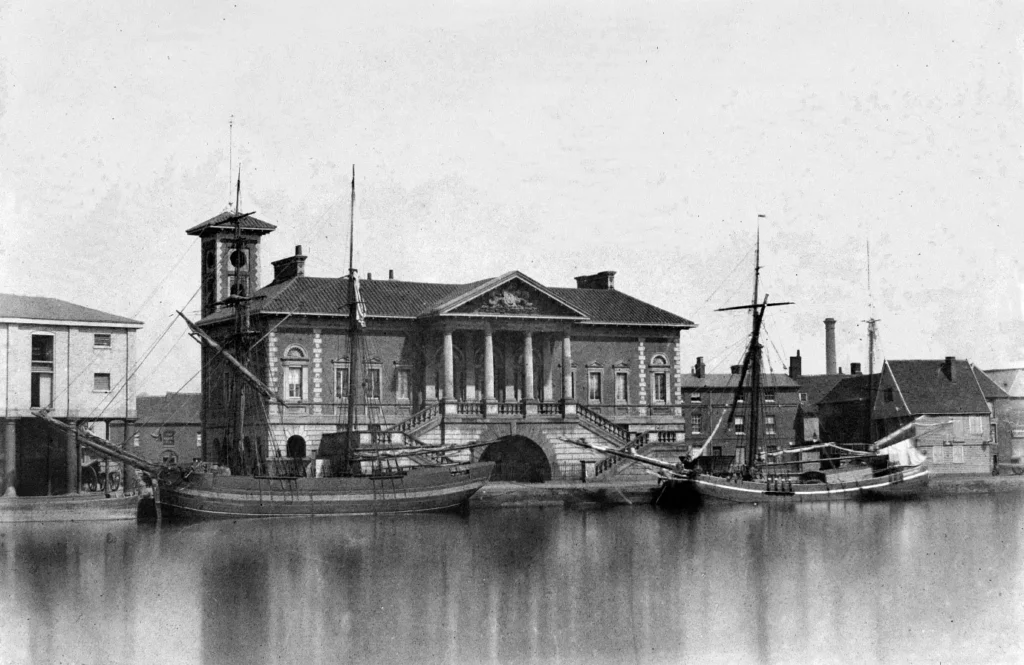
Here we see the brand new Custom House as it looked just after it was opened. This photograph has been identified as one of the most important images in the history of photography. It was taken by a local pioneer photographer John Wiggin in 1848, and is remarkable for its clarity. You can see the clock had yet to be inserted into its tower!
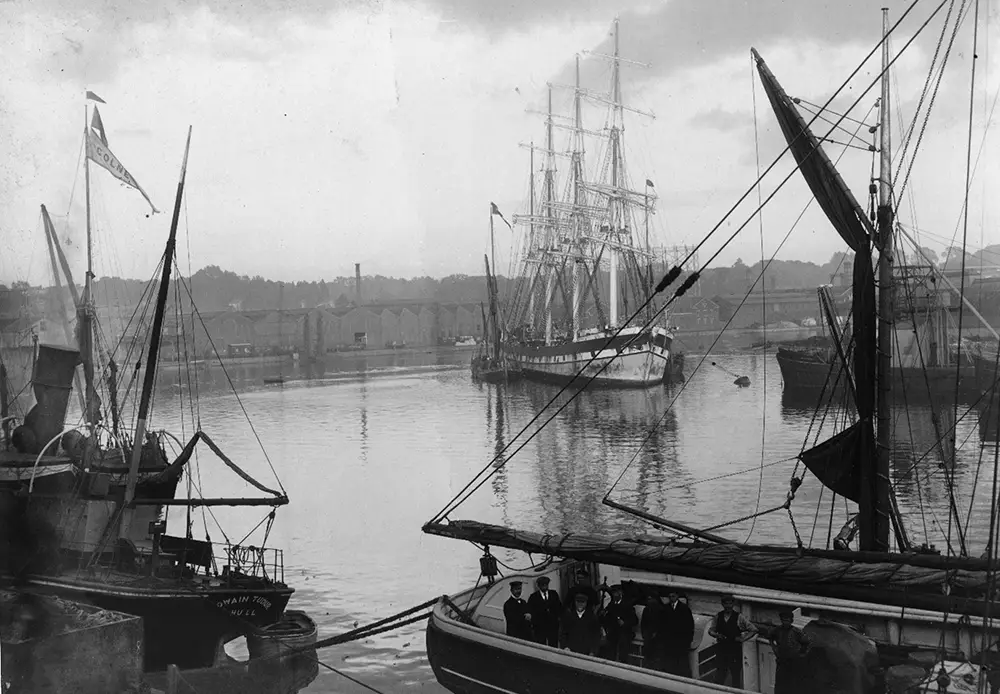
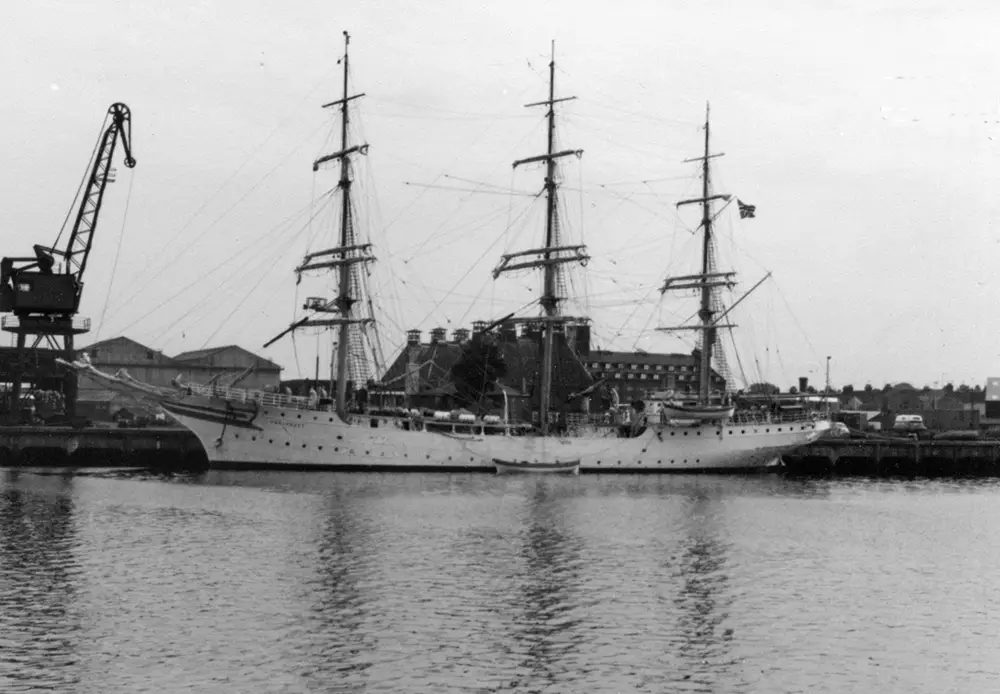
Outside, the cobbled quayside echoed with the sounds of industry: the creak of cranes, the shouts of dockworkers, and the rhythmic clatter of carts hauling barrels and crates. The air was thick with the smell of (salt) malt, smoke, and the scent of spices, mingling with the ever-present tang of the Orwell River. The photographs below show two views looking out from the Custom House building’s stone steps.
Inside the Customs House, the atmosphere was one of order and precision. Ledgers were meticulously kept, tariffs calculated, and inspections carried out with Victorian efficiency. The building’s grand façade reflected the pride Ipswich took in its role as a gateway to the world — a town not just surviving, but thriving in the age of empire and innovation.
As the century progressed, the Customs House bore witness to the changing tides of trade, technology, and society. It stood firm through booms and recessions, wars and reforms, always watching over the dock like a steadfast guardian of Ipswich’s maritime legacy.
Today the Customs House remains the administrative centre of the port’s beating heart, trading with over 120 cities world-wide, including many of the same Hanseatic European cities that it traded with in medieval days.
The photographs for this article are reproduced courtesy of the Ipswich Maritime Trust Image Archive, sourced with permission from Suffolk Archives, David Kindred, Nick Wiggin and ABP respectively.
This content has been developed with generous time and expertise donations from a number of people whom we thank for their contributions. The author of the content is Stuart Grimwade.
There are six binoculars in key historic locations around the town. You can find them all here
You can also download a map kindly curated by Historic Towns Trust on their 1904 map of Ipswich, showing the location of each set of binoculars and what the town around them used to look like.
Photographs from the Ipswich Maritime Trust’s Image Archive helped inform what you see and the content on this website.
Members of the Ipswich Maritime Trust, the Historic Towns Trust, the towns’ Tourist Guide Association and other wonderful members of the public shared their expertise on the history of Ipswich to help guide the designs and keep them accurate.
Our partners at Zubr have made the technology a reality and supported the project at every step, designing the first content themselves and ensuring these are a fantastic addition to Ipswich.
Thanks to our funders
Kindly funded by the Ipswich Towns Fund
If you find anything wrong with our binoculars, please let Ipswich Borough Council know by clicking this link.
Please note the binoculars may be asleep when you approach, give them a wiggle to wake them up.
Brought to you by Ipswich Central, the Business Improvement District (BID) for the town centre and waterfront thanks to Ipswich Borough Council and Towns Deal funding.
The copyright of all content on this site, including images, belongs to Locus Management Solutions Ltd. Company registered in England.